
Industry
The Aviamasters effect: how one plane game spawned a genre
Penguins fired by yetis. Coconuts instead of rockets. A football that halves your counter when it clips a flare. Two years after Aviamasters landed, the format it invented is everywhere — and the copies have something in common that is worth noticing before you play one.
What Aviamasters actually invented
Crash games were already a category before 2024. Aviator had established the shape years earlier: a multiplier climbs, you decide when to take it, and if you hesitate you lose everything. The tension lives entirely in one decision, made under time pressure, over and over.
Aviamasters removed that decision. There is no cash-out button, no moment of nerve. What replaced it was a projectile on a randomised path, a running counter that grows and shrinks depending on what the projectile touches, and a binary ending — safe ground or water. The player's only real input happens before the round starts.
That turned out to be a template rather than a game. Strip the aviation theme away and you are left with a set of instructions any studio can follow: launch something, let it collect and lose value on the way, end on a landing. It is cheap to build, instantly legible to someone who has never gambled, and it films beautifully. Within eighteen months, other people started following those instructions.
The wave
Three releases show how quickly the format travelled, and how far from aeroplanes it got. Specifications below are as published in each game's listing.
| Game | Provider | Released | RTP | The hazard |
|---|---|---|---|---|
| Aviamasters | BGaming | Jul 2024 | 97.0% | Rockets |
| Pengu Sport | InOut Games | Dec 2025 | 96.5% | Stones and ice holes |
| Avia Tropica | Astriona | Apr 2026 | 96.0% | Coconuts |
| Kick & Goal | Pixmove | Jun 2026 | 95.0% | Red flares |
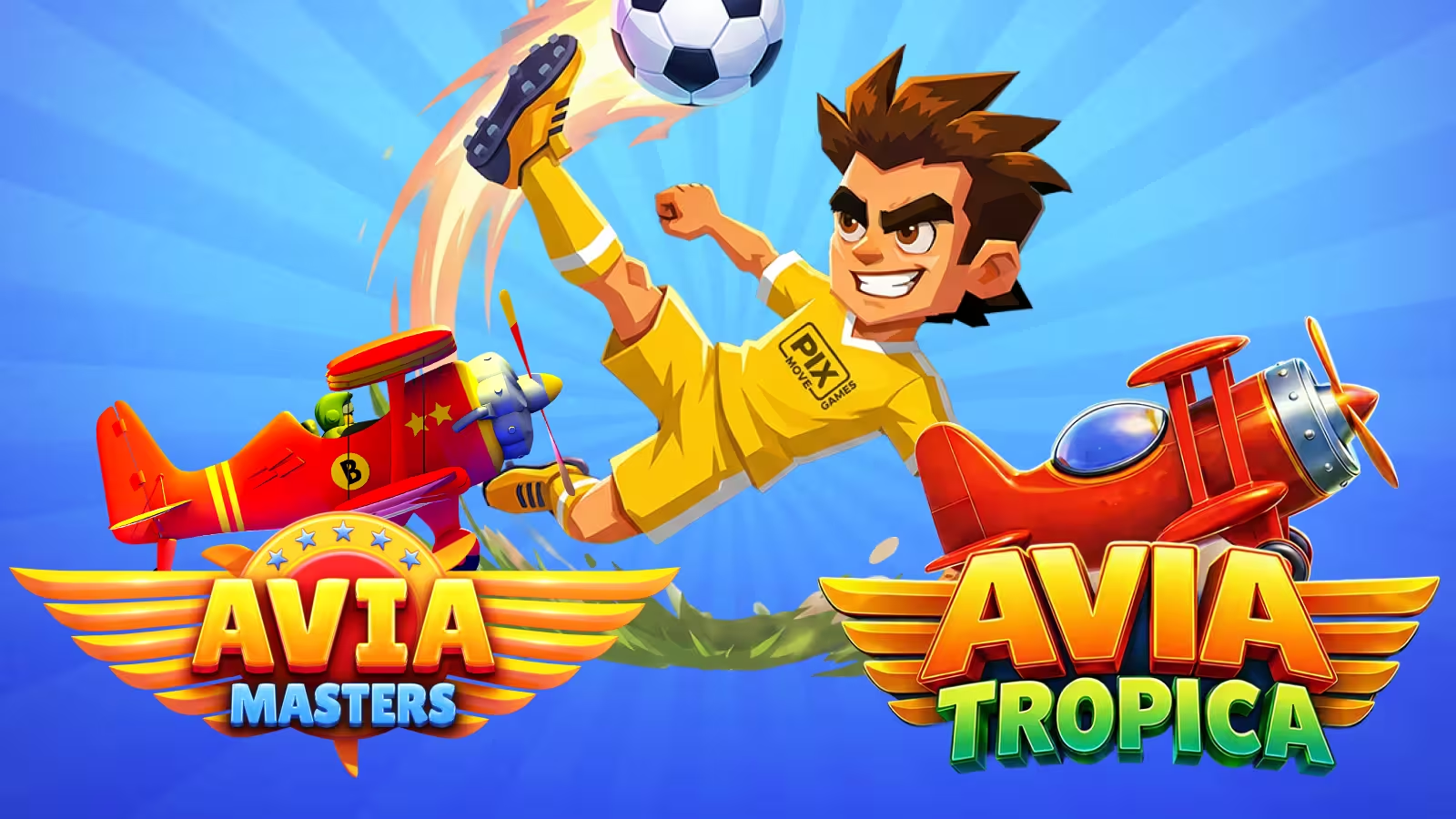
Avia Tropica keeps the aeroplane and swaps rockets for falling coconuts, landing on a beach instead of a carrier. Pengu Sport replaces the plane with a penguin launched by a yeti. Kick & Goal abandons flight altogether for a football crossing a pitch into a goal. The theme has drifted a long way; the machine underneath has barely moved.
The shared DNA
What makes these copies rather than coincidences is not the projectile. It is the hazard rule. In all four games the obstacle does not end the round — it halves the running counter and pushes the projectile downward, making the landing harder to reach. That is a specific, unusual design choice. Most gambling games treat a hazard as terminal because it is simpler to reason about. Aviamasters made it survivable, which is precisely what creates the near-miss recoveries that made it clippable.
Every one of these games reproduces it. Coconuts halve. Red flares halve and drive the ball down. Pengu Sport goes further still and copies the pickup schedule outright: additive symbols at +1, +2, +5 and +10, multipliers from ×2 to ×5, and a halving penalty. Those are Aviamasters' exact numbers.
The supporting furniture repeats too. All four offer selectable animation speeds that change pace without touching the outcome. All four run autoplay with round counts and stop conditions. All three of the newer games use an identical $0.10 to $200 bet range. And every one of them describes itself, somewhere, as drawing on the feel of early flash games — which is the same origin story BGaming has always told about Aviamasters.
What gets lost in the copy
Look at the RTP column again. It descends in release order, without exception: 97.0%, then 96.5%, then 96.0%, then 95.0%. Two percentage points separate the original from the most recent imitation.
That is not a rounding difference. On a 97% game the house keeps £3 of every £100 wagered in the long run; on a 95% game it keeps £5. The second game takes two-thirds more from the same play. For a format built around long sessions of small repeated bets, that gap compounds quickly — and it is invisible while you are playing, because the games look and behave almost identically.
This is the practical reason to care about the difference between a pioneer and a copycat. A studio that originates a format has to earn its audience on the strength of the idea, and a generous RTP is part of the pitch. A studio arriving eighteen months later is selling recognition instead — the game already looks familiar, so it does not have to compete on value. The maths quietly absorbs the difference.
Maximum win figures wander in the other direction. Aviamasters caps at ×250 and its sequel at ×1,000, while Pengu Sport advertises ×20,000. A bigger headline number on a lower RTP is not generosity, it is redistribution: the same money paid out to fewer people, less often.
Genre or gold rush?
It would be easy to write all of this off as theft, and that would be too simple. Every gambling category forms this way. Aviator did not invent multipliers; Aviamasters did not invent flash-game physics. A format only becomes a genre when enough studios build in it that players start recognising the shape, and recognition is what turns a novelty into a lobby category. The imitators are part of how that happens.
Some of them add real ideas, too. Kick & Goal moving the mechanic off aviation entirely is a genuinely useful demonstration that the format is not about planes — it works with anything that can be launched at a target. Pengu Sport's rescue mechanic, where a walrus can pull a falling penguin back into play, is a recognisable cousin of the Life Buoy booster but arrived at from a different direction.
The honest distinction is not originality, it is what the studio does with the maths. Building on a format while holding or improving the terms is genre formation. Building on a format while quietly shaving the return is cashing in on the hype. The RTP column tells you which one you are looking at, and it is the only column that costs you money.
What to check before you play one
If a game in this mould catches your eye, three things are worth thirty seconds of attention. Find the RTP in the in-game info screen rather than trusting a listing, and treat anything below 96% as expensive for the category. Check whether the hazard halves or kills, because a terminal hazard is a fundamentally different and harsher game wearing the same clothes. And check the bet range against your actual stake, since a headline maximum multiplier is only reachable at the top of it.
Beyond that, the format is what it is. None of these games reward skill, all of them resolve on a random path decided the instant you commit, and a prettier theme does not change the arithmetic underneath. The one thing that genuinely varies between them is the number in the RTP column — which is why it is the only one worth memorising.
For the original's own story, our first-year figures cover how it got big enough to be worth copying, and the comparison with the sequel covers how BGaming responded to its own success.
Try Aviamasters 2 FreeSpecifications for third-party titles are as published in their game listings and have not been independently verified — check the in-game info screen at your operator, as RTP can vary by configuration. This site is independent and not affiliated with any provider named here. Real-money gambling is for players aged 18 or over — please gamble responsibly.